- The AI Furnace
- Posts
- AI Furnace Newsroom: OpenAI Introduces Ads on ChatGPT, Apple Chooses Google Gemini for Siri, Greenland in the AI Spotlight, Anthropic Launches App for Knowledge Workers
AI Furnace Newsroom: OpenAI Introduces Ads on ChatGPT, Apple Chooses Google Gemini for Siri, Greenland in the AI Spotlight, Anthropic Launches App for Knowledge Workers
The AI Furnace weekly newsletter. Your destination for the latest news, innovations, opportunities, and product launches in AI.

AI Furnace
January 20, 2026

In partnership with

Welcome to this week’s AI Furnace Newsroom
In today’s insights we cover:
OpenaAI Introduces Ads to ChatGPT
Greenland’s Minerals are in the AI Spotlight, but Issues Are on the Horizon
Apple Chooses Google Gemini for Siri Upgrade
NVIDIA and Eli Lilly Invest $1B in AI Drug Lab for “Full Stack” Healthcare
Anthropic Launches Cowork – the Claude Code Equivalent for Knowledge Workers
Read time: 5 mins
💡 Furnace Insights
OpenAI
OpenAI is officially crossing the line it spent years defending: ads are coming to ChatGPT, starting with tests for adult free users and the low-cost Go plan in the U.S. The company says Plus, Pro, and Enterprise will remain ad-free, which makes this less like “ads everywhere” and more like a new monetization layer aimed at its largest, least-monetized audience.
The initial implementation is deliberately cautious. Ads will sit below answers, be clearly labeled, and avoid sensitive areas like politics and health. OpenAI is also drawing a hard boundary in the messaging: ads will not shape replies, and user data will not be sold. Users will be able to see why an ad appeared and provide feedback, which is OpenAI trying to keep this feeling closer to transparent recommendations than traditional ad targeting.
The interesting part is not the ad unit, it’s the surface. ChatGPT is where intent is expressed in full sentences: “What should I buy?” “Which software should we use?” “How do I solve this problem?” Putting a sponsored placement immediately under that answer turns ChatGPT into a high-value commercial funnel, closer to a decision engine than a search box. If this works, it becomes a new kind of distribution channel for brands, one where the assistant can frame the context and the ad can capture the next click.
Greenland

Greenland is taking the stage in the AI race because it sits on critical minerals used across chips and data center hardware, including rare earths and materials tied to semiconductors and fiber optics. As AI demand ramps up, the supply chain has become a geopolitical issue, not just an industrial one.
The catch is that “resources in the ground” are not the same as secure supply. Mining in Greenland is slow and expensive, with harsh operating conditions, limited infrastructure, and significant project risk from permits to politics to price volatility. Even if extraction scales, the value and leverage often sit downstream.
The real choke point is processing and refining. China’s position in refining gives it influence regardless of where raw material comes from. That is why Western efforts increasingly focus on building refining capacity and magnet production, not just sourcing new deposits.
For investors and operators, the takeaway is straightforward: Greenland is not a near-term shortcut to AI hardware independence. The faster, more realistic win is building and scaling refining capacity, plus the logistics and industrial base that turns raw inputs into components the supply chain actually depends on.
Apple
Apple’s decision to use Google’s Gemini models to power a major Siri overhaul is one of the clearest signals yet that the “best assistant” competition is shifting. It is starting to look less like a battle of devices and more like a battle of model stacks, even if those models come from a rival.
Apple is framing the partnership through its privacy posture: processing on device where possible, and otherwise through its own private cloud approach. It is also keeping the ChatGPT integration for more complex queries, which implies Apple is building a brokered assistant experience where different models handle different classes of work.
From Apple’s side, this reads like a pragmatic move to catch up on capability after delays. The company cannot afford Siri to feel behind while competitors push AI deeper into everyday workflows. If Gemini is the strongest available foundation today, Apple is prioritizing user experience and time-to-market over strict model independence.
For Google, the distribution upside is enormous. Getting Gemini inside Siri puts it closer to daily consumer usage at a scale few products can match.
NVIDIA
NVIDIA investing $1 billion with Eli Lilly to build an AI drug laboratory in Silicon Valley is not just a healthcare headline, it is a platform move. NVIDIA is positioning itself as more than the chip supplier for model training. It is moving into domain workflows where AI spend can compound for years.
Drug discovery is a natural target: it is expensive, slow, and information dense, with a clear ROI if AI can shorten cycles or improve hit rates. The partnership framing also goes beyond discovery into clinical development, manufacturing, and commercial operations, which is where large pharma spends real money and where data, simulation, and automation can scale.
For investors, this is another sign that the next wave of AI value creation will come from vertical deployment, not just better general models. The winners will be the ones who translate capability into regulated, high-stakes systems that run end-to-end processes, and lock in long-term infrastructure spend.
Anthropic
Anthropic shipped Cowork, a desktop app that turns Claude into a file system agent for non-technical users. The pitch is straightforward: instead of asking AI to suggest what to do, you give it access to a designated folder and let it organize files, synthesize documents, and generate outputs like spreadsheets with real formulas and presentations, without needing command-line workflows.
Cowork is essentially Claude Code repackaged for mainstream knowledge workers. Anthropic says it runs on the same agent architecture and uses an “agentic loop” where the system plans, executes, checks its work, and asks for clarification when it gets stuck. Under the hood, it relies on virtualization and a sandboxed Linux environment so Claude is confined to the folder you grant. The key design choice is permissions up front, not step-by-step approvals, which is what makes it feel autonomous rather than “assistant-like”.
The competitive subtext is Microsoft Copilot. Microsoft is trying to embed AI at the operating-system and productivity-suite level, while Anthropic is taking a bottom-up approach: start with a powerful agent used by developers, then abstract it into a desktop interface for everyone else.
The tradeoff is the obvious one: execution introduces real downside. If an agent can modify files, it can also delete or corrupt them when instructions are vague. Anthropic acknowledges prompt injection risk and frames safety as “not solved,” even with isolation. For enterprises, that means Cowork is not a blanket rollout tool. It is a controlled deployment product.
📈 AI Venture Deals of the Week
Karavel, an AI compliance platform for regulated industries, raised its $1.25M pre-seed funding round.
Resquad AI, an AI-driven technical recruitment platform, raised its $1.5M Seed round.
Formulary, an AI-native private fund administration platform, raised its $4.6M Seed round.
Ivo, an AI contract review and insights platform, raised its $55M Series B.
Mytra, a supply-chain operating system for warehouses, raised its $120M Series C.
Harmonic, an AI lab building mathematical reasoning models, raised its $120M Series C.
Deepgram, a voice AI speech-to-text and text-to-speech platform, raised its $130M Series C.
Parloa, an AI agent platform for customer service, raised its $350M Series D.
⚒️ New AI Product Launches You Don’t Want to Miss
OpenAI, released its ChatGPT ads test, labeled sponsored recommendations below answers; and also ChatGPT Go, a low-cost ChatGPT subscription with higher limits.
Cowork, a Claude desktop agent that reads/edits files and completes tasks tool.
Claude Code released its Clear Context (plan acceptance), resets context before execution.
Midjourney, released its Niji V7, provides more coherent anime model with better prompt following.
Google releases TranslateGemma, a Gemma 3-based open translation models for 55 languages.
Upcoming Events 📅
AIF Founder Supper Club @ Whiskey Club - Wednesday, January 21
AIF Founder Supper Club @ Wine Bar - Wednesday, February 18
AIF Founder Supper Club @ Private Room - Tuesday, March 24
Interested in meeting the Who’s Who of AI?
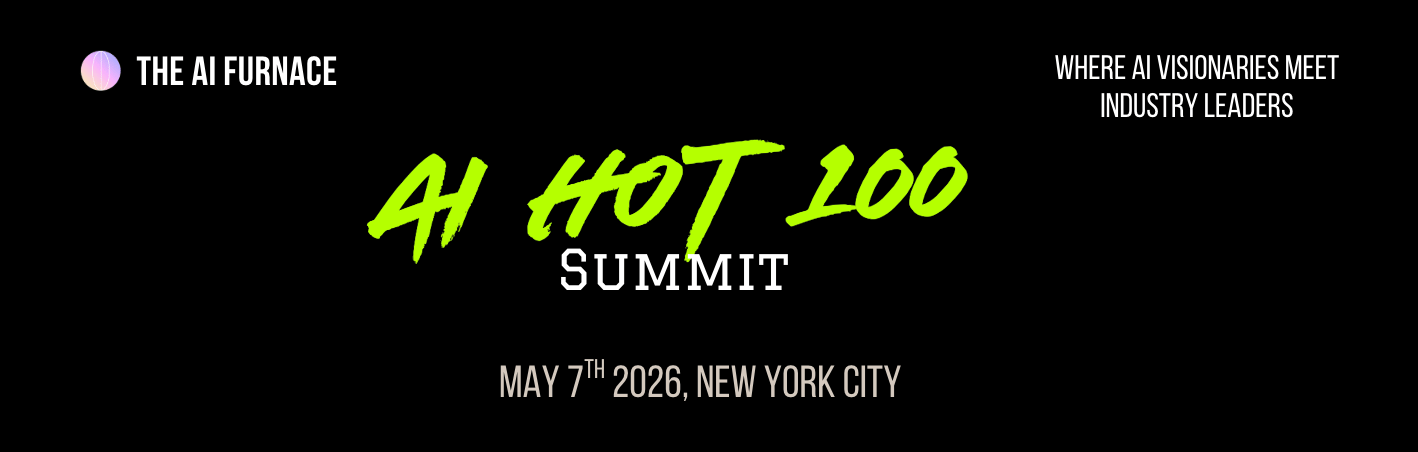
The AI Hot 100 Summit is back for its third edition on May 7th, 2026 in New York City. The only AI Summit built for real connections where AI Visionaries meet Industry Leaders. Join over 500 AI Executive Leaders, Founders and Investors for a jam packed day of enterprise AI lightning talks, innovation showcases, and curated networking.
Get ready to meet and greet speakers and attendees from OpenAI, NVIDIA, Haleon plc, Legora, Anthropic, Cursor, Eleven Labs, Adobe, Walmart, Insight Partners & more.
🗓️ May 7, 2026
📍New York City
📢 Want to partner? Reach out to get your brand in front of 25k+ AI executives, entrepreneurs, researchers, investors, and AI leaders.