- The AI Furnace
- Posts
- AI Furnace Newsroom: Jensen Announces NemoClaw at GTC, Google Launches Personal Intelligence, Anthropic’s 81,000 Interview Campaign, OpenAI Buys Astral
AI Furnace Newsroom: Jensen Announces NemoClaw at GTC, Google Launches Personal Intelligence, Anthropic’s 81,000 Interview Campaign, OpenAI Buys Astral
The AI Furnace weekly newsletter. Your destination for the latest news, innovations, opportunities, and product launches in AI.

AI Furnace
March 24, 2026

In partnership with
Welcome to this week’s AI Furnace Newsroom
In today’s insights we cover:
Jensen Announces NemoClaw at GTC, a Platform Turning OpenClaw into Enterprise Agents
Google Launches Personal Intelligence Across the U.S.
Anthropic’s 81,000 Interview Campaign Shows People Want Productivity, Not Magic
Anthropic’s OpenClaw Killer, Claude Code Channels, Takes the Agent Fight to Telegram and Discord
OpenAI Buys Astral to Deepen Push in Developer Tooling in the Code-Gen Wars
Read time: 5 mins
💡 Furnace Insights
NVIDIA

At the annual Nvidia event, GTC, Jensen Huang posted strong results and chip launches for its hardware division, and he also leaned into the narrative that NVIDIA is no longer just selling GPUs, it’s trying to standardize the software layer that runs on top of them. The headline on the agent side was NVIDIA NemoClaw, an enterprise stack built on OpenClaw.
OpenClaw is the viral open-source agent framework that lets AI agents take actions across tools and services. NemoClaw is NVIDIA’s attempt to make agents “safe enough for procurement”. It adds the stuff companies actually ask for (policy guardrails, privacy/security controls, managed runtime), so SaaS vendors can stop being “software subscriptions” and start packaging outcomes - a paradigm known as agentic-as-a-service. In plain English: instead of selling dashboards, they sell agents that do the work, with NVIDIA quietly collecting the compute bill in the background.
Google is rolling Personal Intelligence out to free U.S. users, expanding Gemini’s ability to pull context from Gmail and Google Photos across AI Mode in Search, the Gemini app, and Gemini in Chrome. It’s opt-in, and Google is leaning hard on “you control the connections” messaging.
Gemini is becoming less of a generic chatbot and more of a personal operating layersitting across the most habit-forming surfaces on the internet (Search + Chrome + Gmail). For everyday users, this is the “stop re-explaining yourself” upgrade. For Google, it’s a moat move: if the assistant knows your context, switching costs rise fast. The tradeoff is trust: Google can’t afford even one moment where “personal” feels like “creepy,” which is why opt-in and controls are the whole product, not a footnote.
Anthropic
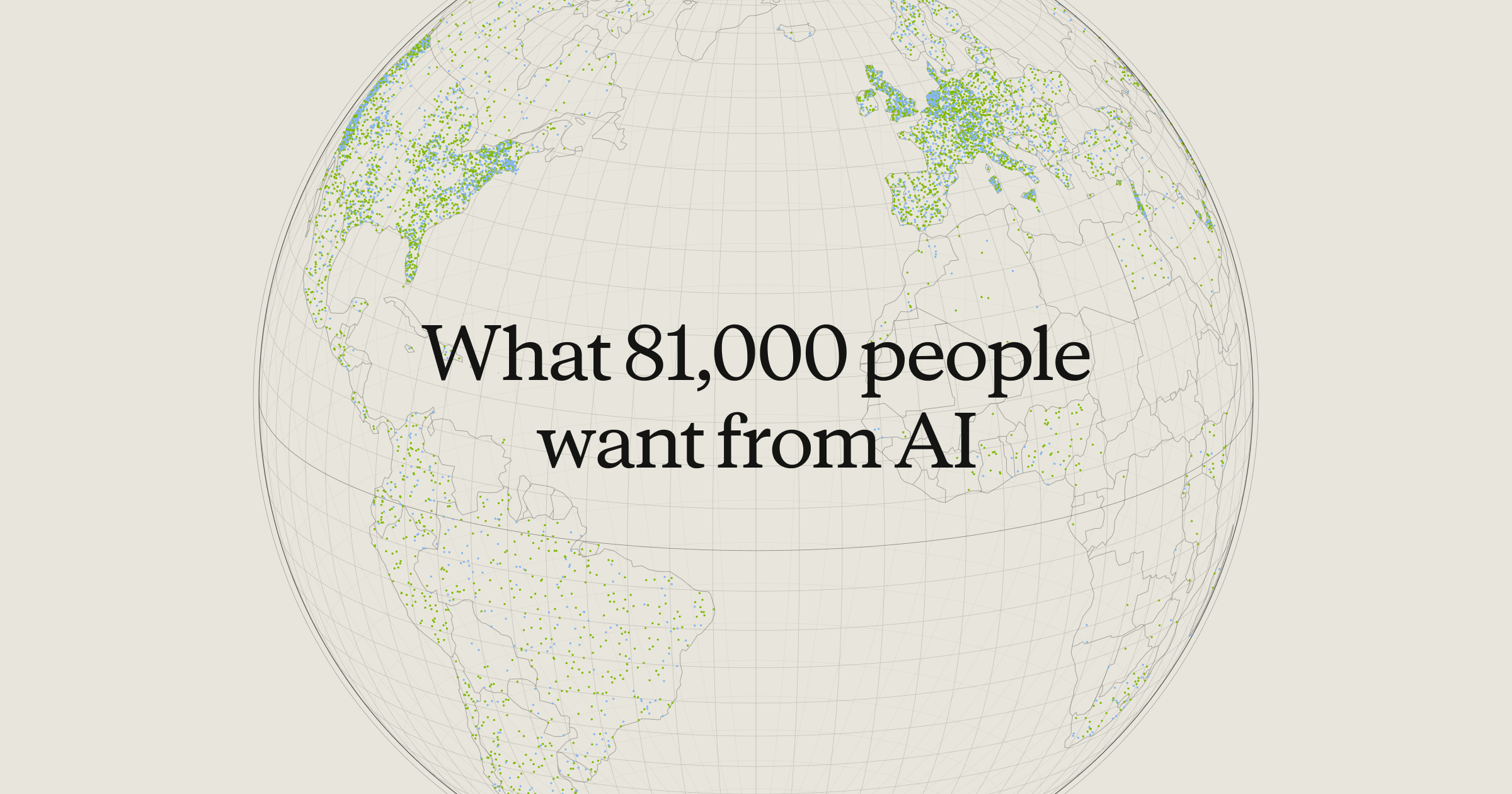
Anthropic used a Claude-powered “Interviewer” to run open-ended conversations with 80,508 people across 159 countries and 70 languages, asking what they want from AI and what worries them. The top aspiration wasn’t creative expression, it was professional excellence: help with routine work so people can do more meaningful tasks.
People want AI to offload the mental load, but they also worry about reliability, job displacement, and loss of autonomy, often in the same breath. And there’s a geography angle that matters for businesses: emerging markets tend to frame AI as a ladder (opportunity), while wealthier regions are more split or cautious. The key lesson: trust and usefulness in daily work are what people keep asking for.
Anthropic
Anthropic just added Claude Code Channels, letting users interact with a Claude Code session through messaging platforms like Telegram and Discord. It’s a very direct response to the OpenClaw vision, whereby agents feel most natural when they live where you communicate and spend time.
Messaging channels turn an agent into something you can ping like a colleague, which is massively sticky for teams. But it also raises the stakes on permissions, because the moment an agent can act across tools from a chat interface, mistakes become operational, not just embarrassing. Expect the next phase to be less about new features and more about guardrails: what the agent is allowed to touch, what it must confirm, and what gets logged for review.
OpenAI
OpenAI announced it will acquire Astral, the team behind widely used Python developer tools like uv, Ruff, and ty. OpenAI plans to bring that expertise into its Codex ecosystem while continuing to support the open-source projects. Thibault Sottiaux from OpenAI said they want Codex to be "the agent most capable of working across the entire software developer lifecycle."
Coding agents are only as good as the plumbing around them: dependency management, linting/formatting, type checking, builds, and repeatable environments. By pulling Astral in, OpenAI is buying speed and reliability for real-world agentic coding, and it’s also quietly tightening distribution: if Codex becomes the place where Python projects get created, checked, and shipped, that’s a much harder position for rivals to dislodge than a benchmark win.
📈 AI Venture Deals of the Week
Raven, a runtime application security platform, raised its $20M Seed.
RunSybil, an AI-native offensive security platform, raised its $40M Series A.
Paraform, a platform that connects tech companies with specialized recruiters, raises a $40M series B.
Flexzo AI, an AI workforce platform for healthcare staffing, raised its $12M Series A.
Deeptune, an AI training simulation platform for agents, raised its $43M Series A.
Dash0, an AI-powered observability and operations platform, raised its $110M Series B.
Wonderful, an enterprise AI agent deployment platform, raised its $150M Series B.
Sigma360, an AI risk intelligence and compliance platform, raised its $17.3M Series B.
⚒️ New AI Product Launches You Don’t Want to Miss
Anthropic introduced Projects in Cowork for organized workflows.
Cursor released its Composer 2 update for long-horizon agent workflows.
AirOps, an AI workflow platform for content creation at scale that helps teams automate and optimize content pipelines.
ByteDance releases DeerFlow, an open-source multi-agent AI orchestration framework, enables complex research and automation workflows.
Lambda, a model catalog and inference platform for LLM deployment, provides benchmarks, guides, and scalable GPU access.
Upcoming Events 📅
AIF Founder Supper Club @ Private Room - Tuesday, March 24
Interested in meeting the Who’s Who of AI? Join the AI Hot 100 Summit in NYC

The AI Hot 100 Summit is back for its third edition on May 6-7th, 2026 in New York City. The only AI Summit built for real connections where AI Visionaries meet Industry Leaders. Join over 500 AI Executive Leaders, Founders and Investors for a jam packed 2 days of enterprise AI lightning talks, innovation showcases, and curated networking.
Get ready to meet and greet speakers and attendees from OpenAI, NVIDIA, Haleon plc, Legora, Anthropic, Cursor, Eleven Labs, Adobe, Walmart, Insight Partners & more.
🗓️ May 6-7, 2026
📍New York City
📢 Want to partner? Reach out to get your brand in front of 25k+ AI executives, entrepreneurs, researchers, investors, and AI leaders.